










Get Marketing Insights First
Subscribe to receive actionable strategies, growth tips, and industry insights delivered straight to your inbox.
When you look at a beautiful Indian carpet, you are not just seeing colors and patterns – you are looking at something made by human hands with patience and skill. India is one of the largest centers for handmade carpet, with millions of artisans working in regions like Kashmir, Jaipur, Bhadohi, and Agra.
In this guide, you will understand the full process step by step, in a simple way, so even if you are new to this topic, you can clearly follow how a carpet is made from start to finish.
Before you start making a carpet, you need to know what design you are going to create. These designs are not random. Each shape and pattern carries meaning.
If you see circles, they usually stand for something that never ends. Zigzag lines can show things like water or lightning. Tree designs often represent life and growth. In many traditional carpets, artisans plan the whole design like a small version of the universe.
To help you follow the design, artisans use something called a Naksha. You can think of it like a map or a coloring grid that shows you exactly where each color should go.
To make a carpet, you need some important tools. Each one has a specific job.
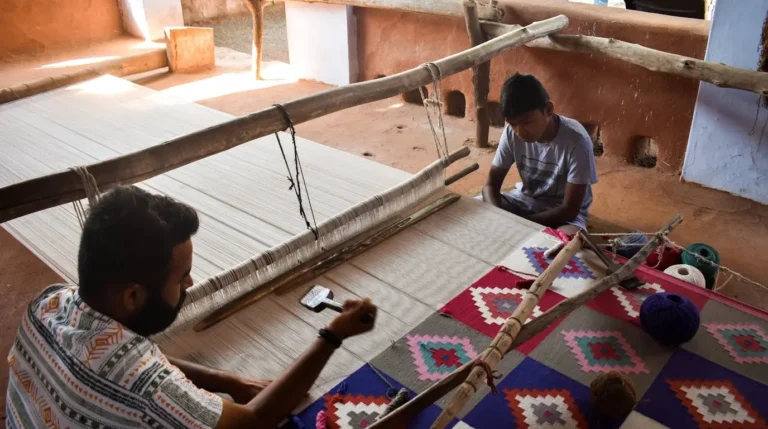
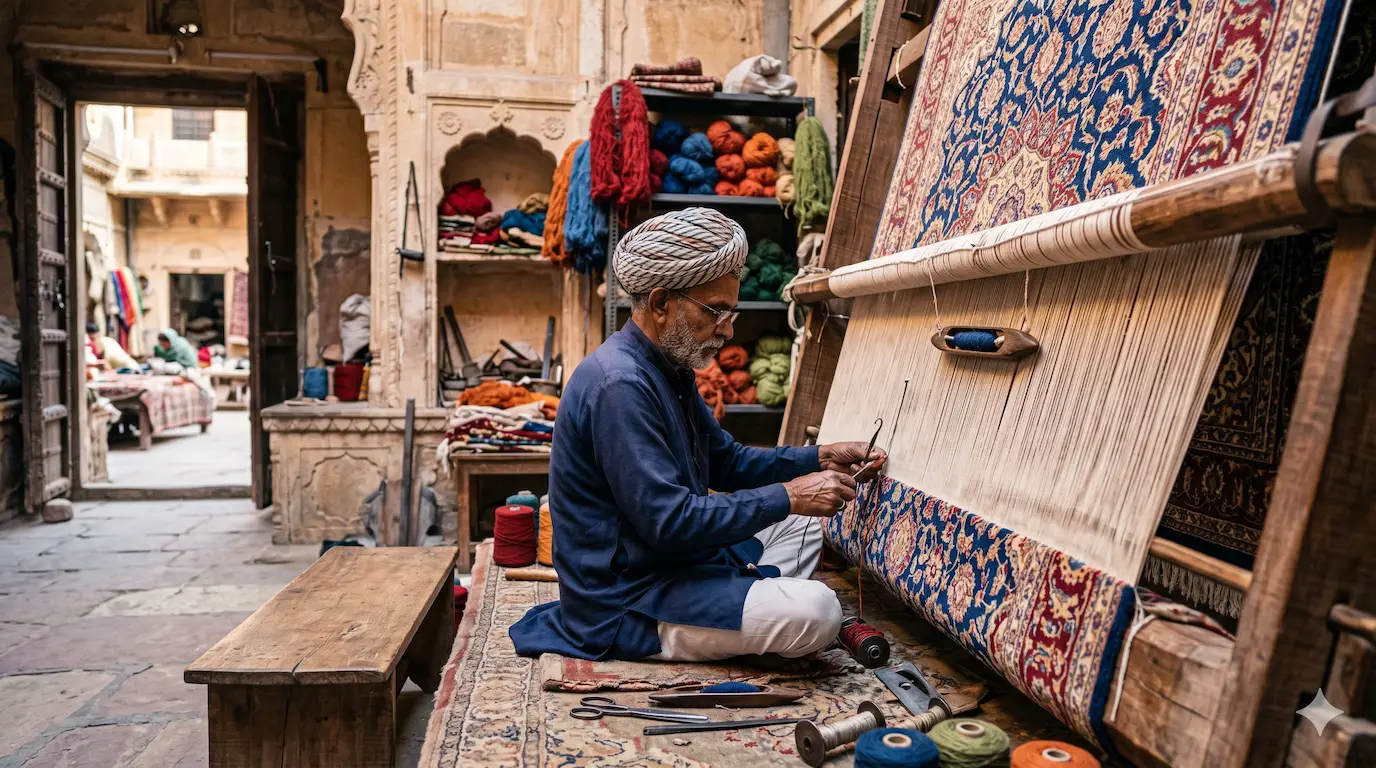
The loom is a large frame that holds the carpet while you work. It keeps everything tight and in place. The Naksha guides you through the design step by step. The Kangi and Punja help you press the threads tightly so the carpet becomes strong. Curved scissors help you trim the surface and make it smooth and even.
Think of these tools like your toolkit; they help you turn raw thread into a finished carpet.
You start by selecting the material. Most carpets use wool, silk, or cotton. Wool is strong and long-lasting, silk feels smooth and shiny, and cotton often forms the base.
Next, you color the yarn. You dip it into hot dye so it absorbs the right shade. After that, you dry and prepare it so you can use it easily while weaving.
Now you prepare the loom. You stretch long threads from top to bottom. These are warp threads, and they form the base of your carpet.
You must keep these threads tight and straight. If they loosen, the carpet will not hold its shape properly.
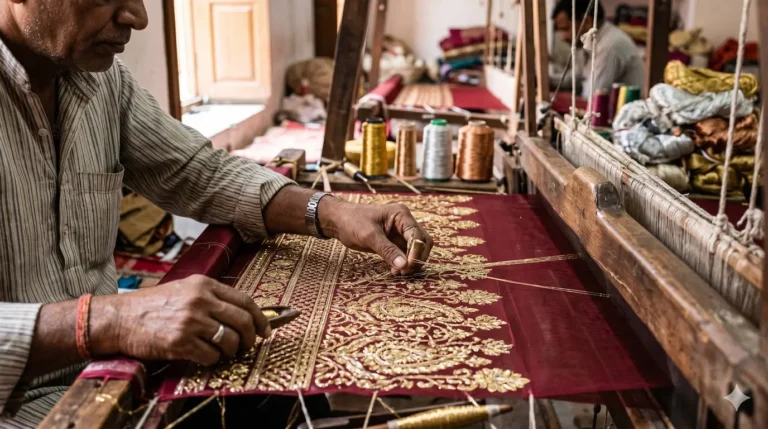
This is the most important part. You sit in front of the loom and follow the Naksha.
You take a piece of colored yarn, wrap it around two warp threads, and tie a knot. Then you cut the extra yarn. You repeat this process again and again, row by row.
In some places, you might hear someone calling out instructions in a rhythmic way. This system is called Talim. It helps multiple people work together while following the same design.
The more knots you make in a small area, the more detailed and high-quality your carpet becomes.
After finishing a row of knots, you pass a thread across the carpet from one side to the other. This is the weft.
Then you use the Kangi or Punja to press everything down tightly. This step makes your carpet strong and long-lasting.
As you continue weaving, the surface becomes uneven. To fix this, you use curved scissors to trim the extra yarn.
This creates the soft surface of the carpet, called the pile. It also makes the design look clear and neat.
Once the carpet is fully woven, you remove it from the loom. But it is still not ready.
You wash it with water and special cleaning solutions. This removes dust and extra dye, and it also makes the colors look brighter.
After washing, the carpet is dried, usually in sunlight. Then it is checked carefully.
Loose threads are trimmed, edges are finished, and fringes are made. After this step, your carpet is finally ready to use.
If you want to check whether a carpet is handmade, you can simply turn it over.
If the design on the back looks almost the same as the front, it means it is handmade. Machine-made carpets usually do not have this level of detail on the back.
When you see a handmade carpet, you are not just looking at a product. You are seeing the effort, skill, and tradition of artisans who have practiced this craft for generations.
These carpets can last for many years, sometimes even decades, because artisans make them with care and strong techniques.
Most carpets are made using wool, silk, or cotton. Wool is the most common because it is strong and durable.
It depends on the size and design. Small carpets may take a few weeks, while detailed ones can take several months.
A Naksha is a design map that shows where each color and knot should go in the carpet.
Talim is a traditional method where instructions are spoken out loud to guide weavers while they work.
You can check the back of the carpet. If the design is clear and similar to the front, it is handmade.
Your thoughts matter to us. Whether you have suggestions, ideas, or just want to share your experience, your feedback helps us improve and create something even better for you.
Take a moment to tell us what you liked, what we can do better, or anything you’d like to see in the future. Every bit of feedback makes a difference!
 Free Shipping on Orders 1499 above