










Get Marketing Insights First
Subscribe to receive actionable strategies, growth tips, and industry insights delivered straight to your inbox.
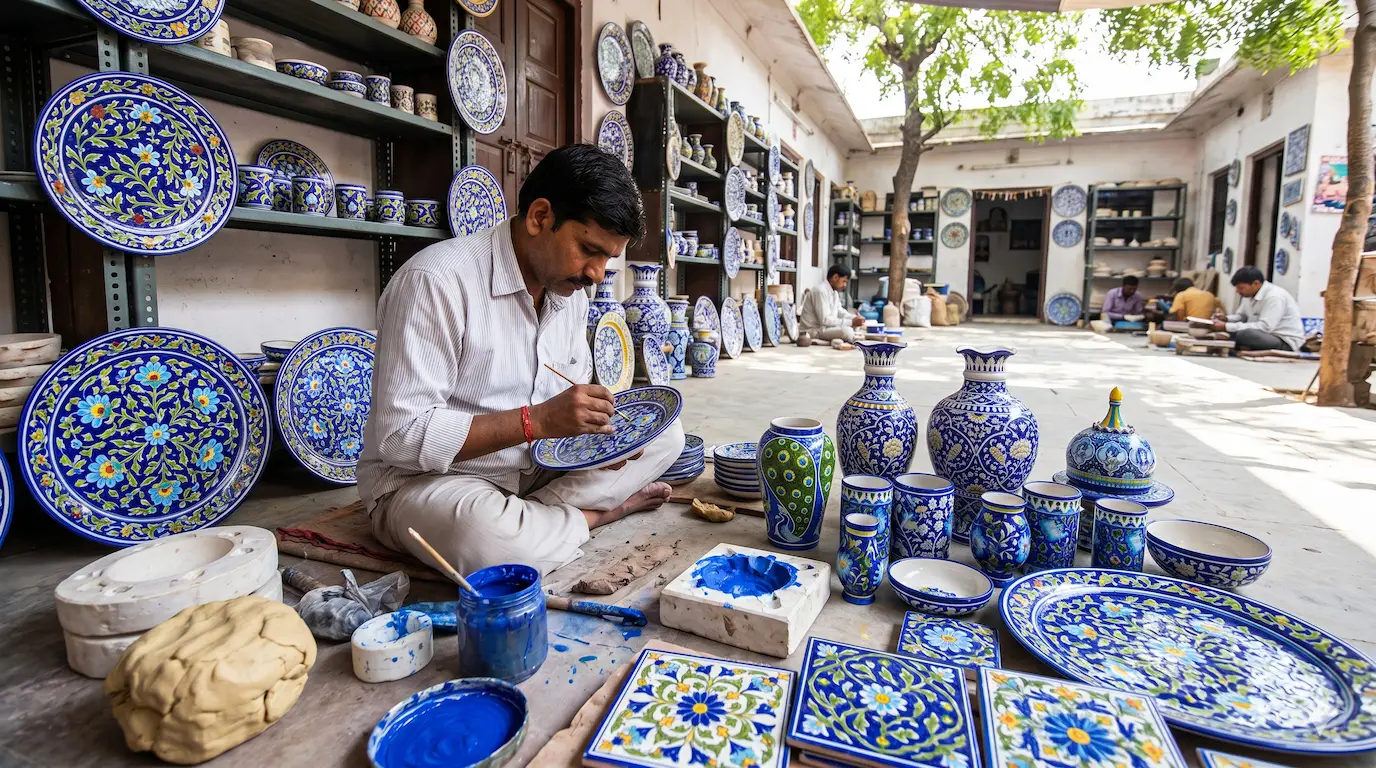
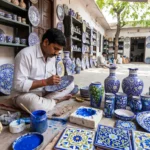
Walk into any traditional craft market in Jaipur and one thing quietly pulls your attention—those cool-toned ceramics glowing in shades of turquoise, cobalt blue, and soft white. At first glance, they look like ordinary pottery. But here’s the twist: there is no clay involved at all.
Yes, you read that right. Jaipur’s Blue Pottery breaks one of the most fundamental rules of pottery-making—and in doing so, creates something entirely unique. Instead of clay, artisans use finely ground quartz stone, glass, and natural gums to shape delicate yet durable pieces that feel almost like porcelain but carry a distinct identity of their own.
But this craft is more than just a technical marvel. It is a story of cultural exchange, royal patronage, artistic pride, and a time when art wasn’t just decoration; it was a statement of identity.
Blue Pottery didn’t originate in India. Its roots trace back to Persia (modern-day Iran), where artisans mastered the art of glazed ceramics using quartz-based materials. These techniques traveled along trade routes, passing through regions like Central Asia and eventually reaching India during the Mughal era.
Under the Mughals, especially in cities like Delhi, the craft found early appreciation. But it was in Jaipur that Blue Pottery truly found its home and evolved into something distinctly Indian.
The turning point came during the reign of Sawai Ram Singh II in the 19th century. Known for his progressive outlook and appreciation for arts and crafts, he invited skilled artisans and encouraged the revival and adaptation of this Persian technique.
What happened next was fascinating:
Let’s break the biggest surprise; how is pottery made without clay?
Instead of traditional clay, artisans use a special mixture made from:
This mixture is kneaded into a dough-like consistency, rolled, and pressed into molds.
Because this technique creates:
Think of it like baking with a completely different ingredient list but still ending up with something beautiful, and in this case, even more delicate.
If Blue Pottery had a personality, it would be calm, elegant, and slightly regal.
The most recognizable feature is its color palette:
These colors come from natural oxides:
What makes these hues special is how they interact with the glaze. Once fired, the colors appear luminous, almost glowing from within the surface.
Look closely at a Blue Pottery plate or vase, and you’ll notice it’s never just “design.” It’s storytelling.
Common motifs include:
Each piece is hand-painted, meaning no two items are exactly the same. Slight variations are not flaws—they are signatures of the artisan’s hand.
During the era of Sawai Ram Singh II, art wasn’t something you casually bought to match your sofa. It was deeply tied to status, culture, and identity.
Blue Pottery found its place in:
Owning such pieces signaled refinement and cultural awareness. It reflected a connection to both global influences (Persia) and local pride (Rajasthan).
In a way, Blue Pottery became a visual language:
“This is who we are—rooted in tradition, yet open to the world.”
Creating Blue Pottery is a slow, meticulous process that requires patience (and a steady hand).
The quartz mixture is kneaded until smooth and workable.
Instead of a potter’s wheel, molds are used to shape items like plates, tiles, bowls, and vases.
The shaped pieces are left to dry naturally. This stage is crucial—too fast, and cracks appear.
Artisans rub the surface with stone or sandpaper to achieve a fine finish.
Designs are lightly drawn using charcoal or pencil.
Using fine brushes, artisans paint intricate patterns with mineral-based colors.
A transparent glaze is applied, giving the piece its signature shine.
Finally, the pieces are fired in a kiln at relatively low temperatures compared to traditional pottery.
Blue Pottery may look effortless, but behind every piece lies a series of risks:
Unlike mass-produced ceramics, there’s no “quick fix” here. Each piece demands attention from start to finish.
There was a time when Blue Pottery nearly disappeared. Industrialization and changing tastes pushed traditional crafts to the margins.
But in recent decades, efforts by designers, NGOs, and artisan communities have revived interest.
Today, Blue Pottery is used in:
Interestingly, modern buyers are not just purchasing a product—they’re buying a story, a heritage, and a connection to something authentic.
In a world filled with machine-made perfection, Blue Pottery offers something rare: human imperfection with character.
It reminds us that:
And perhaps most importantly, it reconnects us with a time when craftsmanship defined identity.
Imagine placing a Blue Pottery plate on your wall. It’s not just filling space—it’s bringing in:
That’s what makes it powerful. It’s not loud or flashy, but it carries depth.
Today, Blue Pottery is inseparable from the identity of Jaipur.
Just like:
…it represents a living tradition that continues to evolve.
For platforms supporting artisans, this craft becomes more than a product category—it becomes a story worth preserving and sharing.
If you’re planning to explore Blue Pottery, here’s what matters:
And yes, avoid expecting perfection. The charm lies in its individuality.
Blue Pottery is a beautiful contradiction.
The art without clay.
It’s foreign yet deeply local.
It’s delicate yet enduring.
From the royal courts of Sawai Ram Singh II to modern homes, it has traveled through time without losing its essence.
And maybe that’s the real magic; Not just how it’s made, but what it represents.
Because of its dominant use of cobalt blue and turquoise shades, even though other colors are also used.
Yes, it is more delicate than regular clay pottery due to its quartz base.
Some items are safe for dry food, but it’s best to use them mainly for decorative purposes unless specified.
It doesn’t use clay and is made from quartz stone, giving it a unique texture and finish.
Relatively yes, as it uses natural materials and traditional processes with minimal industrial impact.
Because it is handmade, time-intensive, and involves skilled craftsmanship.
Enjoyed exploring the story of Blue Pottery? Whether you’re a curious reader, a shopper looking for authentic pieces, or someone learning about traditional crafts; we’d genuinely love to hear from you.
Your feedback isn’t just helpful; it shapes how we share stories, support artisans, and improve your experience.
 Free Shipping on Orders 1499 above